
DC Fast Charging for Large Commercial Carparks: What the Load Calculation Actually Involves
Gain expert engineering insights into transformer sizing, electrical demand calculations, Dynamic Load Management (DLM), and smart infrastructure planning to design cost-effective, scalable, and future-ready commercial EV charging projects
- 👤 SIOTA Engineering Team
- 📅 July 2026
- ⏱️ 10 Min Read
Article Summary
DC Fast Charging infrastructure is transforming commercial mobility across India. However, successful deployment depends on much more than selecting high-power chargers. Engineers must accurately calculate electrical load, evaluate transformer capacity, assess peak demand, and implement intelligent load management strategies to ensure reliable, efficient, and scalable charging operations.
This guide explains the complete load calculation process used by engineering teams while designing large commercial EV charging facilities.
Key Takeaways
- ⚡ Understand how electrical load is calculated for DC Fast Chargers.
- 🔌 Learn how transformer sizing impacts project cost.
- 📊 Discover how Dynamic Load Management reduces infrastructure investment.
- 🚀 Explore future-proof charging infrastructure planning.
- Avoid common design mistakes in commercial EV deployments.
Table of Contents
- Introduction
- Why Load Calculation Matters
- Understanding Connected Load
- Maximum Demand Calculation
- List Item Transformer Capacity Planning
- Power Distribution Design
- Dynamic Load Management
- Future Expansion Planning
- Common Engineering Mistakes
- Conclusion
- Frequently Asked Questions
Introduction
As electric vehicle adoption continues to accelerate, commercial property owners, fleet operators, shopping centres, office complexes, and public parking facilities are rapidly investing in DC Fast Charging infrastructure. While selecting the right charger is important, the real engineering challenge begins with accurately calculating the electrical load required to support multiple high-power chargers.
An incorrect load calculation can result in overloaded transformers, excessive infrastructure costs, voltage instability, higher demand charges, and limited scalability for future expansion. Proper electrical planning ensures that charging infrastructure remains reliable, efficient, cost-effective, and compliant with local electrical standards.
In this guide, we explain how electrical engineers perform load calculations for large commercial car parks and why modern technologies such as Dynamic Load Management are becoming essential for future-ready EV charging infrastructure.
Engineering Insight
Electrical load calculation is the foundation of every commercial EV charging project. A well-designed load assessment minimizes infrastructure costs while ensuring reliable charging performance today and scalability for tomorrow.
Why Load Calculation Matters
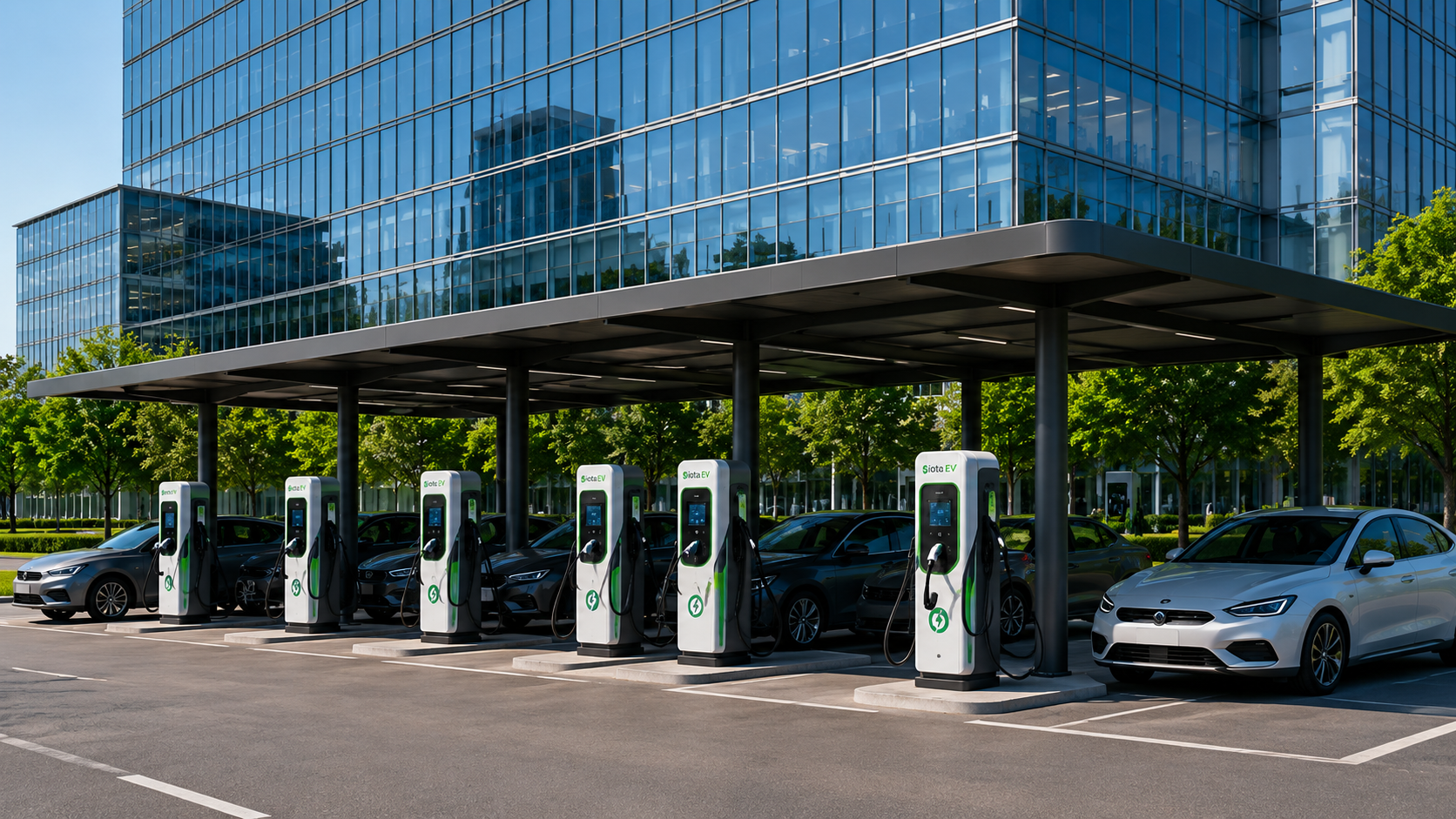
Load calculation is the foundation of every successful commercial EV charging project. Before selecting chargers, transformers, switchgear, or electrical panels, engineers must determine how much electrical capacity the site can safely support.
An accurate load calculation helps balance power demand, minimizes unnecessary infrastructure upgrades, reduces operational costs, and ensures reliable charging performance. It also provides the flexibility required for future expansion as EV adoption continues to grow.
- ⚡
Reliable Power Delivery
Prevents electrical overloads and ensures uninterrupted charging performance.
- 💰
Lower Infrastructure Cost
Avoids unnecessary transformer upgrades and oversized electrical systems.
- 📈
Future Expansion
Supports additional chargers without major redesign of the electrical network.
- 🛡️
Safety & Compliance
Keeps the installation compliant with electrical standards and operational safety.
Understanding Connected Load
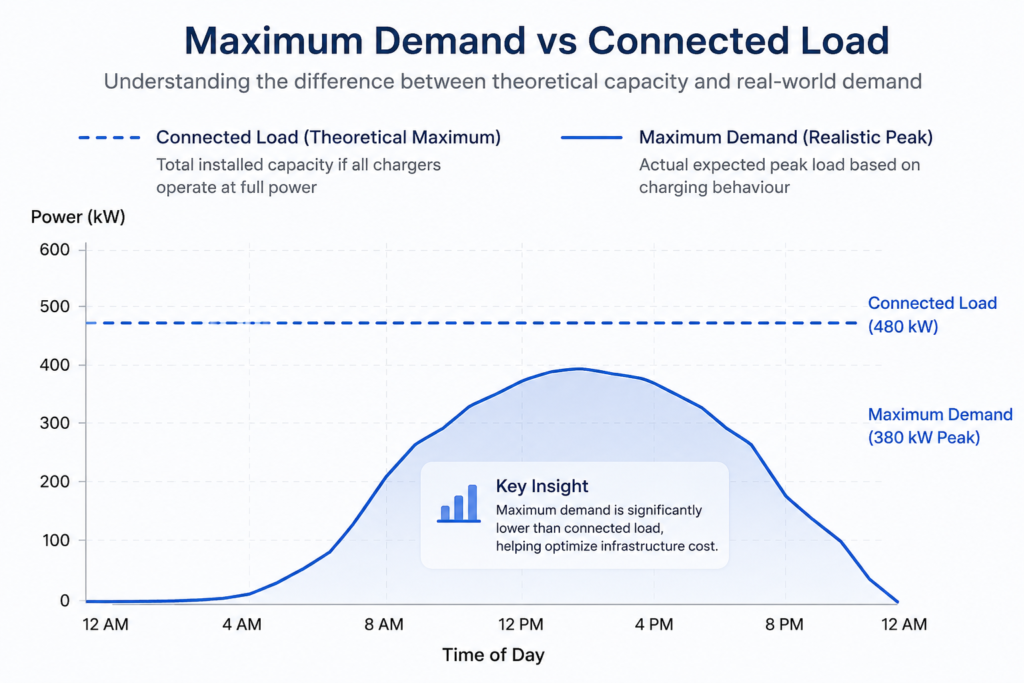
Connected load refers to the total rated power of all EV chargers installed at a site if they were operating at full capacity simultaneously. It represents the maximum theoretical electrical demand before applying diversity or load management factors.
For example, if a commercial car park installs four 120 kW DC Fast Chargers, the connected load is:
4 × 120 kW = 480 kW
However, in real-world operation, not all chargers run at maximum output continuously. This is why engineers also calculate maximum demand and apply Dynamic Load Management to optimise infrastructure costs.
Formula
Connected Load = Number of Chargers × Rated Charger Power
Example Calculation
4 DC Fast Chargers × 120 kW = 480 kW Connected Load
Maximum Demand vs Connected Load
While connected load represents the total installed charging capacity, maximum demand is the highest electrical load expected during actual operation. Engineers use charging patterns, diversity factors, and user behaviour to estimate maximum demand instead of assuming every charger operates at full power simultaneously.
Accurately estimating maximum demand allows businesses to reduce transformer sizes, optimise electrical infrastructure, and significantly lower project costs without compromising charging performance.
Connected Load
• Total installed charger capacity
• Assumes every charger runs at 100%
• Used for initial equipment sizing
Maximum Demand
• Real expected peak power demand
• Considers charging behaviour
• Helps reduce infrastructure cost
Dynamic Load Management: The Smart Way to Optimize Commercial EV Charging
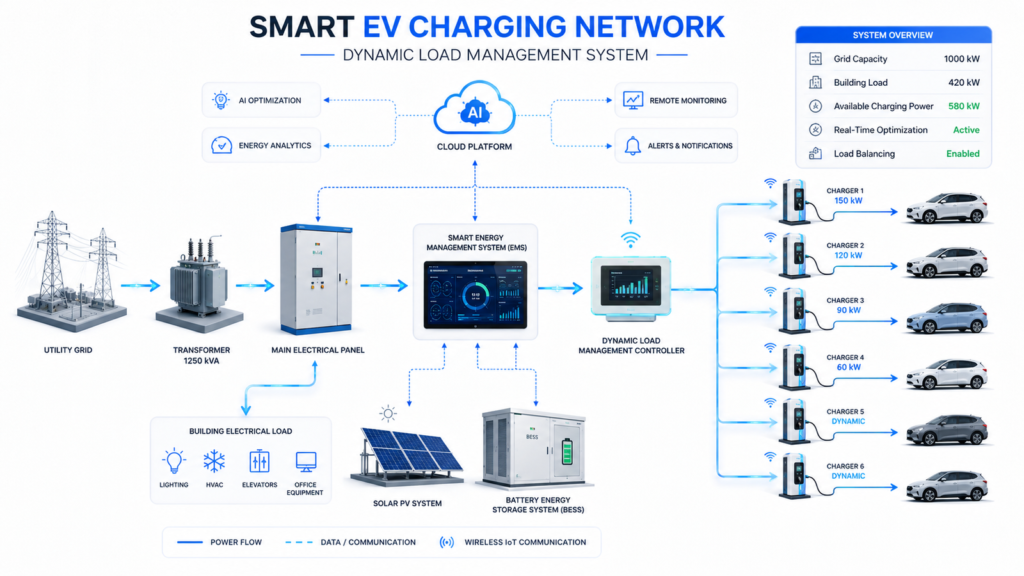
Dynamic Load Management (DLM) is an intelligent energy management system that automatically distributes available electrical capacity among multiple EV chargers in real time.
Instead of designing infrastructure for the maximum theoretical connected load, DLM continuously monitors the site’s available electrical capacity and adjusts charger output accordingly. This enables businesses to install more charging points without upgrading transformers or electrical infrastructure, significantly reducing capital expenditure while maintaining reliable charging performance.
- ⚡
Optimized Power Distribution
Automatically balances available electrical capacity across all active chargers.
- 💰
Lower Infrastructure Cost
Reduces the need for larger transformers, switchgear and costly grid upgrades.Automatically balances available electrical capacity across all active chargers.
- 📈
Future Scalability
Supports additional EV chargers without major electrical redesign.
Conclusion
Designing commercial EV charging infrastructure goes far beyond selecting fast chargers. Accurate load calculations, proper transformer sizing, and intelligent Dynamic Load Management are essential for building reliable, scalable, and cost-effective charging networks.
By understanding connected load, estimating maximum demand, and implementing smart energy management, commercial operators can reduce infrastructure costs, improve charger availability, and prepare their sites for future EV adoption.
A well-engineered charging system is not just an investment in today’s mobility needs—it’s a foundation for tomorrow’s electric transportation ecosystem.
Planning a Commercial EV Charging Project?
SIOTA helps businesses design, optimize, and deploy scalable commercial EV charging infrastructure with expert engineering, load analysis, and smart energy management solutions.